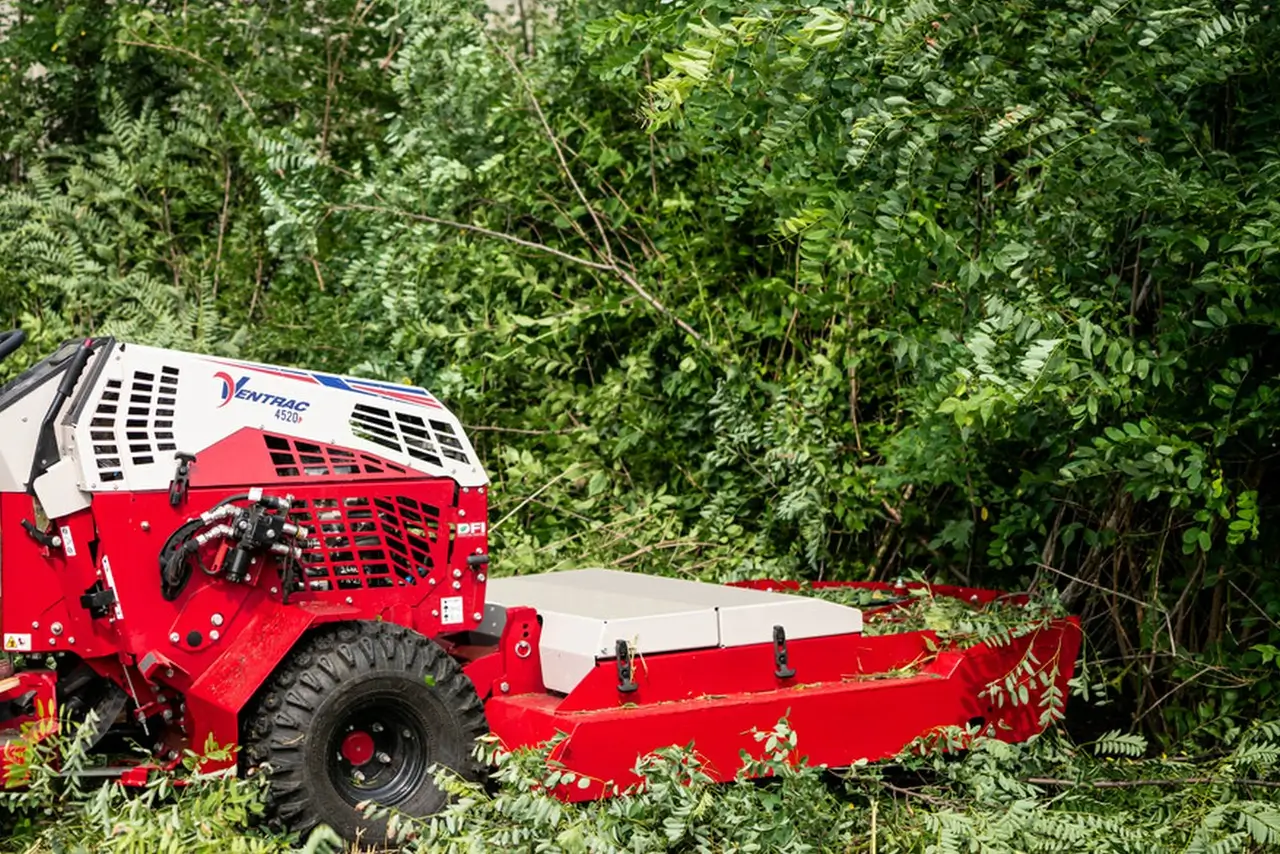
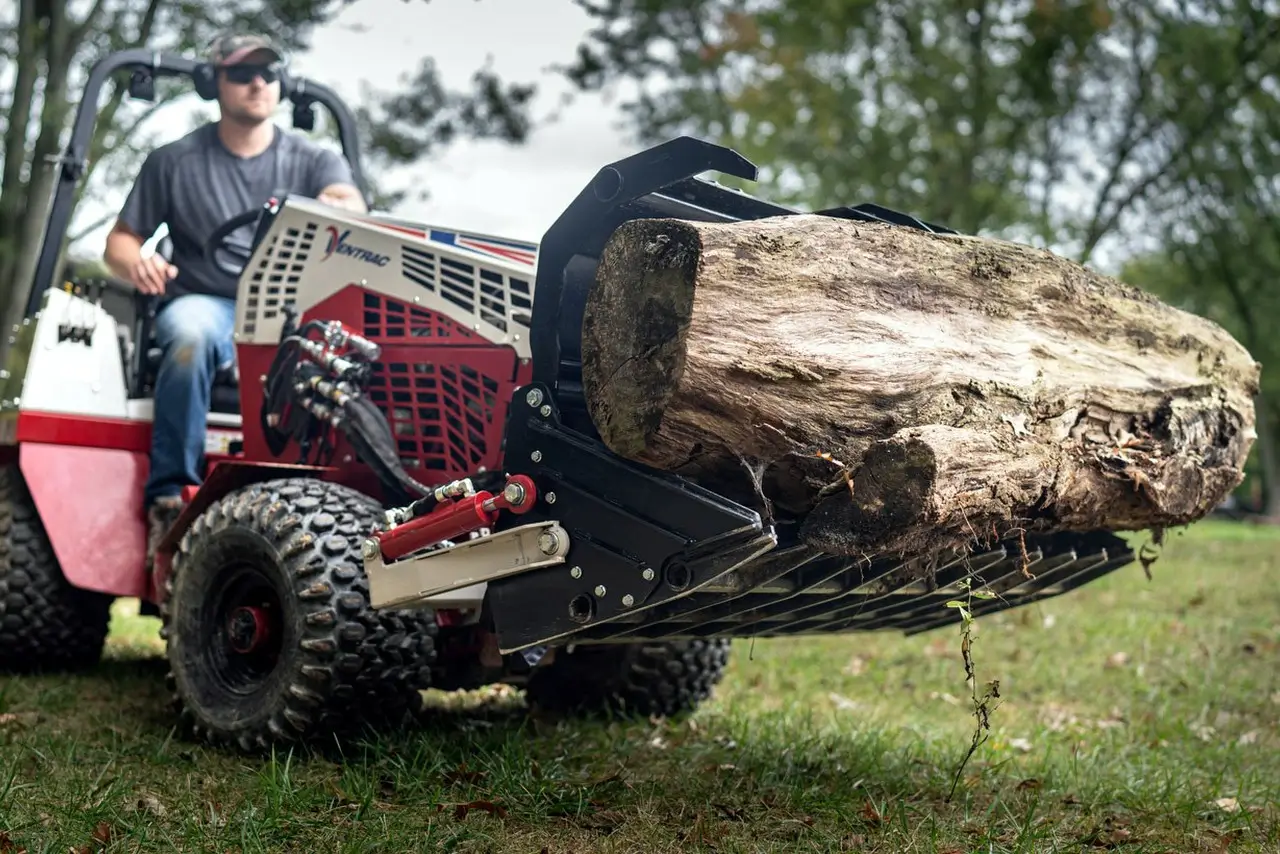
Venrac offers multi-versatility. Over 35 attachments offer Versatility of function. Its low center of gravity, articulating steering, and flex frame oscillation deliver excellent traction and stability, enabling versatility across varying terrains. Its light footprint enables versatility across a range of conditions, operating in soft, wet soil where alternative equipment may leave tears, ruts or get stuck.
How does it compare?
Ventrac has so many functions that it can be compared to varying pieces of equipment, including a compact tractor, skid steer or a zero-turn mower. Since zero-turn mowers are so popular, let’s compare Ventrac mowing to zero-turn mowing.
• Ventrac will be able to mow places the zero turn can’t go, like a steep pond dam or soft swampy areas.
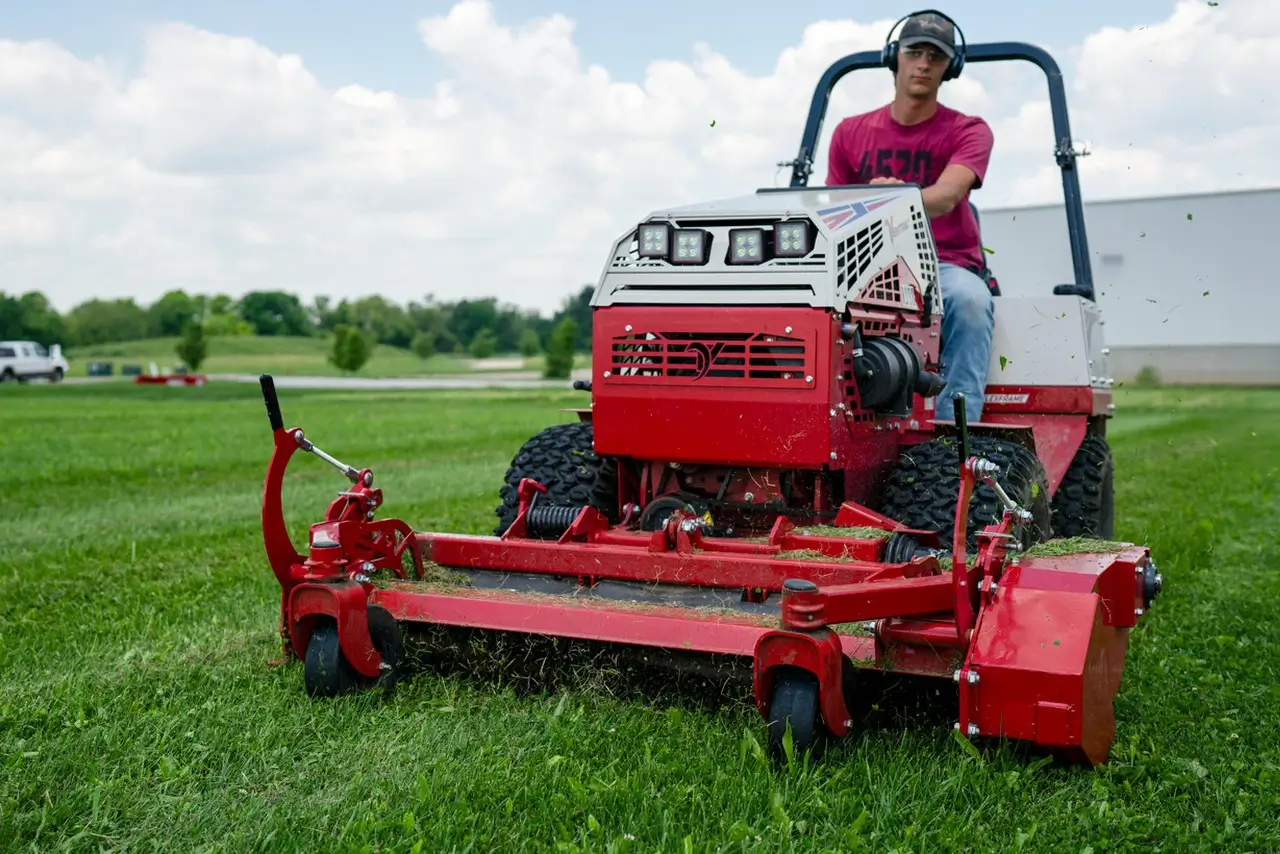
• Even in places where the tractor’s eight tires can’t reach, the Front Deck design allows the deck to reach beyond the tire footprint, like out over the edge of a pond bank or under a fence.
• Ventrac mowing decks are True Floating Decks, meaning that the deck is sitting on the ground, controlling its own height independent of the tractor frame. This support consists of a large roller across the entire back of the deck, caster wheels on the front corners, and anti-scalp wheels between the casters. This will follow the terrain contour far better than a zero-turn mower and stripe far better than a zero-turn mower. Scalping is not an issue for zero turns in most conditions, but in those conditions where scalping is an issue, the Ventrac True Floating Deck will virtually eliminate scalping. That’s true even of the Ventrac 95” wide-area mowing deck.
• Prolonged rains can often lead to rapid turf growth while leaving turf so tender that a zero-turn can’t travel across it without tearing it up. Ventrac can mow in almost any condition, including when it is raining and after days of rain.
• One might assume that going from twin stick controls to a steering wheel would reduce productivity. And compared to traditional steering wheel mowers, that would be true, but Ventrac’s articulating steering frame, combined with its front-mounted deck, allows the operator to literally move the deck left and right, allowing a very similar mowing pattern and productivity of a zero-turn mower.
Those are just the ways it is better at mowing. Add to that the ability to aerate and seed in places you previously could not reach or in conditions you couldn’t previously operate in. Ventrac’s aeravator operates in hard, dry ground as well as damp, soft ground, and in the places only a Ventrac can reach.
Keeping leaves off the turf in the fall after overseeding can be a challenge when the turf is tender after rain or irrigation. Once again, Ventrac’s low-disturbance light footprint enables blowing and mowing in conditions where other equipment would be impractical.
Then add the functionality to grade gravel drives with the power rake, grind stumps, trench, haul gravel, soil, logs, or brush, and much more, and to perform these functions in places most equipment can’t reach, or in conditions in which most equipment can’t operate, this is multi-versatility.
From a lifespan standpoint, Ventrac is built to last. It’s common to see them at several thousand hours, and it's not unheard of to see them reach the mid-teens. They are likely to outlast a commercial zero-turn mower by a factor of 3.
Compared to a traditional 3-point hitch tractor, the Ventrac is more convenient in a few ways. An experienced operator can attach or detach most attachments in about 60 seconds with no tools and no help. By placing the attachment at the front of the tractor rather than behind, the operator can look straight ahead rather than over their shoulder, and vegetation or soil is not packed down before the attachment reaches it. It can handle terrain and conditions that a conventional tractor would not be suited to.